






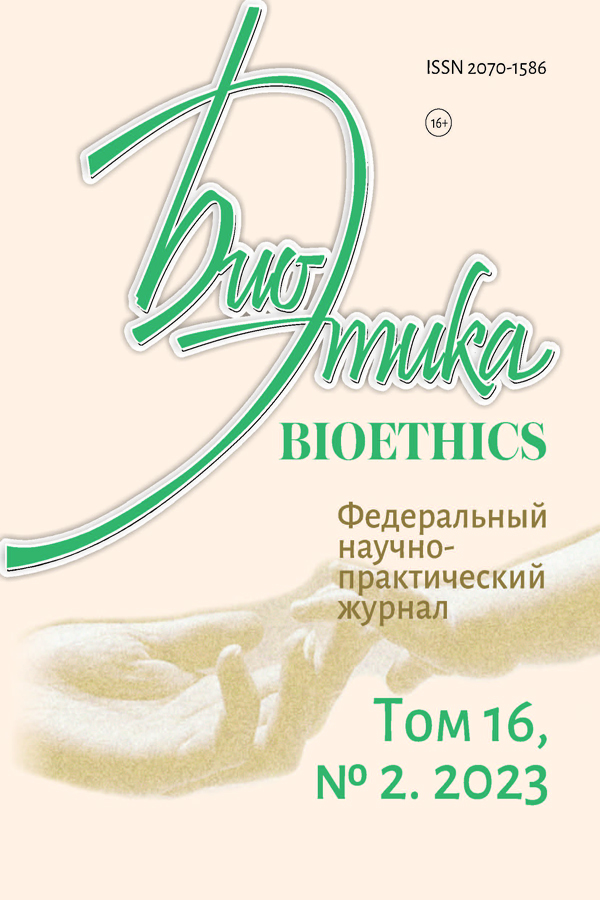
Bioethics journal
Peer-review semiannualy academic journal.
Editor-in-chief
- Prof. Vladimir I. Petrov, MD, Dr. Sci. (Med.)
ORCID: 0000-0002-0258-4092
Publisher
- Volgograd State Medical University
WEB: https://www.volgmed.ru/en/
About
The need for such a publication as the "Bioethics journal" was realized at the beginning of the XXI century in connection with the following events:
- Adoption of the International Convention on Human Rights and Biomedicine. Russia endorsed the Convention, but did not accede to it due to the lack of the ethical and legal framework in this area. It was necessary to create it.
- International contacts of researchers in the field of natural sciences and, above all, medicine, could not be carried out without sanctions from ethical committees. They have already begun to be created in Russia, but it was necessary to seriously improve the qualification of their members. Educational programs and a platform for the exchange of experience were needed.
- Since 2001, Bioethics has become an obligatory academic discipline in medical universities in Russia. There was no system for retraining and / or enhancing the staff of bioethics teachers in the country. It was necessary to develop a teaching and methodological base for them.
- The introduction of new biotechnologies into the practice, first of all, medical ones, required research on the social risks associated with them. Ethical filters for the implementation of human enhancement technologies, the prediction of the negative effects of neurobiological constructs, editing the human genome, ART, the convergence of living and nonliving, regenerative medicine, etc.
All this has become an urgent task, which only bioethics could solve.
Types of accepted articles
- reviews
- systematic reviews and metaanalyses
- original research
- letters to the editor
- short communications
Publications
- in English and Russian
- semiannualy, 2 regular issues per year
- continuously in Online First
- with NO Article Processing Charges (APC) for all authors
- distribution in Open Access,
under the Creative Commons Attribution-NonCommercial-NoDerivatives 4.0 International
(CC BY-NC-ND 4.0)
Indexation
- Russian Science Citation Index
- eLibrary.ru
- Google Scholar
- Ulrich's Periodicals directory
- WorldCat
- Crossref
Current Issue
Vol 16, No 2 (2023)

Editorials
Interdisciplinary connections in the teaching of bioethics
Abstract
As you know, the moral side is in all our relationships, actions and thoughts. The procedure for evaluating on a scale of "good – bad" immediately translates judgments about reality into an ethical plane. This is most clearly seen when working with living objects, which makes bioethics a metascience. This, in turn, requires special methods, skills and ways of explication of value bases. And since the axiological portrait of reality is subjective and has a high degree of variability, the permanently ongoing dispute about the structure and content of education in the field of bioethics is unlikely to have an unambiguous solution. Therefore, the bioethical paradigm of intentionality is so important in educational practices in this field of knowledge.
 3-7
3-7


Theoretical bioethics
Bioethical deconstruction of the phenomenon of evil
Abstract
The phenomenon of evil in modern socialcultural situation from the point of view of bioethics, interpreted as deconstruction is analyzed in the article. Evil as the striving to destruct appears in the form of the dividing of whole and extreme reductionism. In social and anthropological dimensions such reductionism is expressed in the idea of the society as original chaos (war of all against all) which is caused by “evil and vicious human nature”. However this chaos is structured by means of social contract (financial order) coming out in the form of the principle of a lesser evil. Now this structuring is the process of substitution at the new type of order: surveillance biocapitalism. This last is the real threat not only to human existence but to the whole bios. From here is the task of the developing of discourse which is able to block given destructive tendency. Such discourse is conservative bioethics as radical ethics of salvation, on the basis of which the global bioethos can be formed. Global bioethos is the topos of cooperation and solidarity (Great Harmony). In this new social topos Homo misericordis can rise: human whose main quality is misericordia. Owing to misericordia human overcomes estrangement, enters into a dialogue, and creates the premises for the meeting with Other (the whole totality of bios).
8-12
Moral values in Ancient Greek Aesthetics
Abstract
Characterizing the ancient aesthetics, we adhere to the moral approach of the correlation of aesthetic and moral categories, which allows us to reveal the logic of the development of the relationship between aesthetics and morality.
In our study, an attempt has been made, in general terms, to consider the development of aesthetics not as the evolution of concepts, terms, theories, but as an essential factor in the development of morality, morality, ethics, how the understanding of beauty, beauty and harmony in art determined a person's perception of himself and the essence of his actions.
13-19
Practical bioethics
Problems of norm and pathology in the sociology of health
Abstract
Currently, the norm is usually understood as a certain average, the most common indicator in society. The concept of norm changed and as a result, different standards of health (ancient, adaptive, anthropocentric) were distinguished in different time periods. In the modern postmodern world, there is an intensive reassessment of norms, individual and social consciousness is changing, the concepts of good and evil, norms and pathology are blurring, where the old norm, which contradicts the new views on success, can be canceled and introduced into the status of pathology.
The changes also affected medical practice. So, the reforms of F. Pinel (1793) imbues insanity with a certain medical meaning, the condition or behavior begins to be defined as a medical problem requiring medical intervention. Psychiatry gains professional power over the patient, and the psychiatrist gains control over the soul and body of the patient. A psychiatrist, remaining the ultimate truth, determines a person's place in the structure of society through diagnosis and stigmatization mechanisms. In addition, new risks are being created in the company. Biomedical technologies regulating the processes of birth, prolongation of human life and death are being developed.
20-25
The Ethics of Artificial Intelligence: A Sociological Approach
Abstract
Background: to create effective mechanisms for state regulation of potential moral challenges caused by the widespread introduction of artificial intelligence technologies, it is of practical interest to study the attitude of society to this problem. The purpose of the work is a sociological analysis of the attitude of the Russian society to the introduction of artificial intelligence technologies.
Materials and methods: A comprehensive analysis of data from open access databases of All-Russian Center for the Study of Public Opinion was carried out. The materials of sociological surveys for the period 2007 to 2023 were used. Data weighted by socio-demographic parameters.
Results: The majority of respondents believe that AI cannot completely replace humans (78 %). The greatest fears of the population (noted by 50–65 % of respondents) are associated with the loss of personal data and violation of privacy boundaries, the loss of personal responsibility for erroneous actions. Every third noted the risks of violation of civil rights and social guarantees ("increases inequality", "violates the balance of interests of society and the individual"), potential ethical problems ("artificial intelligence has no morals and ethics" – 32 %).
Conclusion: Distrust of AI technologies is associated with an understanding of the social risks of their integration and an awareness of the loss of human values of communication, creativity, and individuality. Particular risks in this context are presented for social institutions of education and healthcare, where the loss of interpersonal communication calls into question the manifestation of empathy, sympathy and compassion.
26-31
Bioethical and sociocultural aspects of diagnosis disclosure
Abstract
Aim: The aim of the article was to analyze various approaches to diagnostic disclosure considering its bioethical, sociocultural, psychoemotional and sociolinguistic implications.
Results: Diagnosis disclosure is considered to be one of the major challenges of doctor – patient communication as it brings forth complex bioethical, legal, sociocultural, and psychoemotional tensions. The former non-maleficence approach to diagnosis delivery has been replaced with the one based on the bioethical principle of patient autonomy obliging physicians to reveal information truthfully and completely. The current bioethical approach has been refined to develop a number of protocols used for effective delivery of negative diagnostic information. However, alongside with the protocols building on this principle, alternative ways of diagnosis disclosure and patterns of diagnosis breaking are practised. The latter rest on culture specific norms, which are followed to balance the principles of non-maleficence and patient autonomy.
Conclusion: The rationale behind the selection of the best approach to diagnostic disclosure has to rest not only on the dominant bioethical principle, but also align with the sociocultural norms as this is the way to ensure greater flexibility, variability and optionality and achieve better management outcomes.
32-36
Applied Bioethics
Modern aspects of deontology in dentistry
Abstract
Background: The basic norms of deontology for a dentist we can find in the Code of Ethics of the Dental Profile.
The aim of the article was to review and analyze the norms of deontology set forth in the Code of Ethics of the Dental Profile.
Results: The article deals with modern aspects of compliance with confidentiality standards. The paragraphs of the Code concerning the relationship between a doctor and colleagues are analyzed and the features of interaction in dentistry are shown. The issues of maintaining a balance between the principles of "do no harm" and "do good" in terms of the patient's financial costs are considered: any intervention is associated with the possibility of causing harm, while the very concept of "harm" includes both the physical side and the moral and financial side. The role of empathy in building relationships in the doctor-patient system is shown. Due to the specifics of the work of a dentist, the importance of moral support for the patient, as well as the importance of informing him about upcoming actions and manipulations, is described.
Conclusion: The patient must be involved in the treatment process, be an active participant in it: it is necessary to provide him with full information to the patient about the methods of treatment, alternative options and possible risks, this ensures the observance of the principle of patient autonomy and respect for his dignity.
37-40
Taking care of yourself in the context of a healthy lifestyle
Abstract
Within the framework of the article, an attempt was made to consider the category of a healthy lifestyle through ontological comprehension, through the experience of being-toward-death and being as suffering. In the context of a healthy lifestyle, self-care should be based on the philosophical principles of self-care, a balanced diet, its relationship with physical activity and rest, on the example of the principles promoted in various ancient educational schools. The ontological structure of self-care, part of which is a healthy lifestyle aimed at combating human suffering and ill health, a way of self-organization, restoration of integrity, acquisition of wisdom, manifested in the existential practice of the art of life, focused on the preservation and enhancement of health.
41-45
Ethical and legal responsibility of medical organizations and medical workers for causing harm to the life and health of patients while carry-ing out professional activities
Abstract
Аuthors, consider the issues of recognizing the subjects of civil liability for causing harm to life and health, patients of specific medical institutions, regardless of their form of ownership and doctors of these institutions. It also raises the issue of the recognition of private doctors who are individual entrepreneurs as the subjects of this type of liability.
46-51
Cultural and historical context of understanding health: analysis of opinions and traditions of the peoples of the world
Abstract
This article analyzes the opinions and traditions of the peoples of the world in the context of understanding health. The authors investigate cultural and historical factors influencing the idea of health and methods of health improvement, including traditional medicine, cultural practices and beliefs. The article describes different approaches to understanding health, including Western medicine, traditional Chinese medicine, Ayurveda, and other traditions, and examines factors influencing acceptable health treatment and care practices in different cultures. The findings may help health professionals better understand the multicultural nature of understanding health and develop more effective strategies for treating and preventing disease.
52-56
Events
BRICS Medical and Humanitarian Development Association (AMEGRA BRICS): birth and first steps
Abstract
The BRICS Medical and Humanitarian Development Association (AMEGRA BRICS) was established on January 17, 2023, receiving final registration as a legal entity on May 11, 2023. One of the central tasks of the Association is the creation of an International University of Integrative Medicine on the basis of one of the medical universities in Russia.
57-58
New Philosophy Workshop for Medical Specialties
Abstract
The publishing house "KNORUS" has released a new textbook by the head of the Higher School of Medical Humanities of the Institute of Public Health of the Volgograd State Medical University of the Ministry of Health of Russia, Professor Natalya Sedova "Philosophy for medical specialties. Practicum" [1]. Volgograd State Medical University remains one of the leaders in the development of innovative teaching aids in the field of medical humanities. "Philosophy for medical specialties. Praktikum" is the sixth educational publication of this type, published by the central Russian publishing house of educational literature. All of them have the UMO stamp, and four of them are winners of the All-Russian competition of educational literature in the nominations "Textbook of the Year" and "Recognized Leader".
59-60